Column · 9 September 2026
4 lectures
At the Eiffel Tower, French women were hidden so as not to offend a guru
On Saturday, 5 September, a delegation from the Hindu movement BAPS was granted a private visit to the Eiffel Tower on one condition accepted by management: keep female staff out of the way. Women were pulled from their posts, some were replaced by men, others were told to wait out of sight in back rooms. On Monday the national monument shut down. Behind SETE’s belated apology and the Socialist City Hall’s outrage lies a single fact: in Paris, equality between the sexes recedes the moment a foreign religious demand arrives at the foot of the Iron Lady.
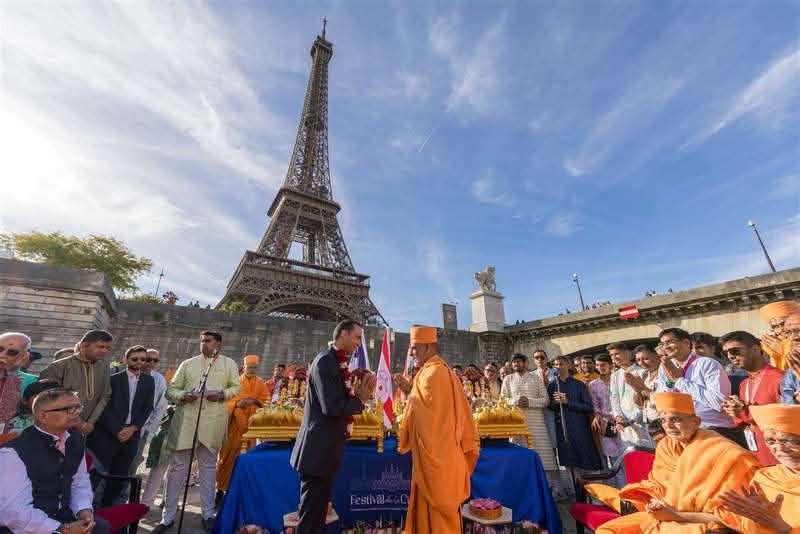
There are scenes one no longer expected to see in France. Not in a dystopian novel. Not in a report from some distant country. Here. Under the Iron Lady. Last Saturday, a delegation of about a hundred people from the Hindu movement BAPS — Bochasanwasi Akshar Purushottam Swaminarayan Sanstha — obtained a private visit to the Eiffel Tower. The condition accepted by management: limit “interactions with women.”
In practice, that meant this. Female employees — including staff from contractor firms — were ordered off their posts. Some were replaced on the spot by men. Others were confined to annexes and service rooms, out of the spiritual leader’s sight. All were instructed not to cross certain zones while the group moved through. At least twenty women, according to Diane Davoine, CGT representative on the works council of the Société d’Exploitation de la Tour Eiffel (SETE).
“They were asked to leave their workstations. They were deliberately replaced by men at certain posts.” The word she uses next is not a slogan: invisibilisation. Humiliation. Erasure. In public space. On the most photographed monument in France.
On Monday, 7 September, the staff walked out. The Eiffel Tower stayed shut all day. Families and tourists from around the world received a terse text: visit cancelled, refund by email. No explanation on site. The symbol of France, closed. Not because of a storm. Because of a surrender.
A temple, a guru, an imported rule
The visit was not a random diplomatic courtesy. It formed part of the inauguration festival for France’s first traditional stone Hindu temple, opened on 6 September in Bussy-Saint-Georges (Seine-et-Marne), on the so-called Esplanade of Religions and Cultures. Several thousand square metres of stone carved in India and assembled in the Paris region, presented as the largest mandir of its kind in mainland Europe.
BAPS is a worldwide religious organisation. Its monks (sadhus) take a vow of celibacy that forbids them to speak to women, touch them, sometimes even to cross their path without necessity. That is not a secret: it is doctrine. What is new is that a publicly controlled French company — the City of Paris owns 99 percent of SETE — agreed to bend the running of a national monument to that rule.
SETE itself admitted it: the delegation had asked that the spiritual leader’s visit be organised so as to limit “interactions with women.” Then, once the scandal broke, came the statement of contrition: “These conditions should not have been accepted. They comply neither with SETE’s values nor with the principles of equality between women and men.”
Translation: first they said yes. They apologise later, when the cameras arrive.
BAPS, for its part, issued “sincere apologies” while denying it had requested “differentiated treatment between women and men.” No one, it claims, was denied access. Move along. The problem is that the tower’s management says the opposite. And that the women who work there received a clear order: disappear.
The variable-geometry feminism of the Paris left
Paris mayor Emmanuel Grégoire (Socialist) called the situation “unacceptable” and announced an inquiry “as soon as possible.” Ariel Weil, Socialist mayor of Paris Centre and president of SETE, spoke of “somewhat overzealous middle managers,” insisted he had “obviously” not known, and promised to “draw all the necessary conclusions.”
We know the script. Outrage after the fact. An internal inquiry. A mid-level scapegoat. No one at the top had “been informed.”
Yet Davoine says it plainly: for a delegation of that size, “there is necessarily a link with the state, one way or another.” Instructions came down. Orally. Nothing in writing. Front-line managers merely executed.
That is the real political scandal. Not only that a religious group formulated a demand incompatible with French law. That the demand was met. In Paris, self-proclaimed capital of women’s rights, run for years by a left that turns every 8 March into a civic liturgy, hunts “everyday sexism” in adverts and schoolbooks, and plasters the streets with slogans about equality.
The moment the request is religious and comes from elsewhere, the dogma flips. One must not “stigmatise.” One must “welcome.” One must “dialogue.” French women are put in a windowless room.
That is actually existing wokism: a feminism that screams at an awkward compliment in the office, and looks away when women are hidden at the foot of the Eiffel Tower so as not to offend a 93-year-old monk. An anti-racism that treats any reminder of the 1905 law, civil equality and laïcité as a cultural assault. A “living together” which, in practice, means making the host country step back.
This is not diversity. It is a substitution of norms.
For twenty years we have been told that immigration and multiculturalism enrich France. Here is the finished product. Not a dish, not a street festival. A foreign religious rule applied, for the length of a visit, to the most French monument there is. Women must vanish. Men take their place. The cultural welfare state smiles, then apologises.
No one is asking Hindus to renounce their faith. France has citizens of every origin, and freedom of worship is not negotiable — within the law. That law forbids discrimination on the basis of sex. Article 1 of the Constitution. The Labour Code. The Penal Code. One does not adapt a public site to a visitor’s taboos, even a “spiritual” visitor, even one linked to a foreign power, even one escorted by flags and processions.
If tomorrow another delegation demands that unbelievers, homosexuals, Jews or unveiled women be set aside, where does it stop? SETE has already answered, once: we adapt, then we issue a press release.
The tower reopened on Tuesday morning. The City’s and SETE’s inquiries will produce reports. There will be talk of a “dysfunction,” of “procedures to review,” of a future “VIP protocol.” The sentence that stings will be avoided: France is not obliged to become the stage for other people’s separatisms.
A national monument is not a hotel. A French employee is not a ritual obstacle. And equality between the sexes is not a totem one leaves in the cloakroom the moment a guru steps out of a car.
If this country still has a shred of pride, the answer fits in one line: here, the women stay at their posts. Full stop.