Column · 16 September 2026
3 min read · 7 reads
Associate Member: A Word. Not a Treaty
In Strasbourg, Ursula von der Leyen offered Canada a title that appears in no EU treaty: “associate member.” Applause, an embrace, a blue map. The gesture is strong. The contract is not written. Between the photo and the Montreal summit, the real question remains what that word actually means — and how much Ottawa is prepared to give up to wear it.
“Associate Member”: A Nice Label Stuck on a Contract That Doesn’t Exist
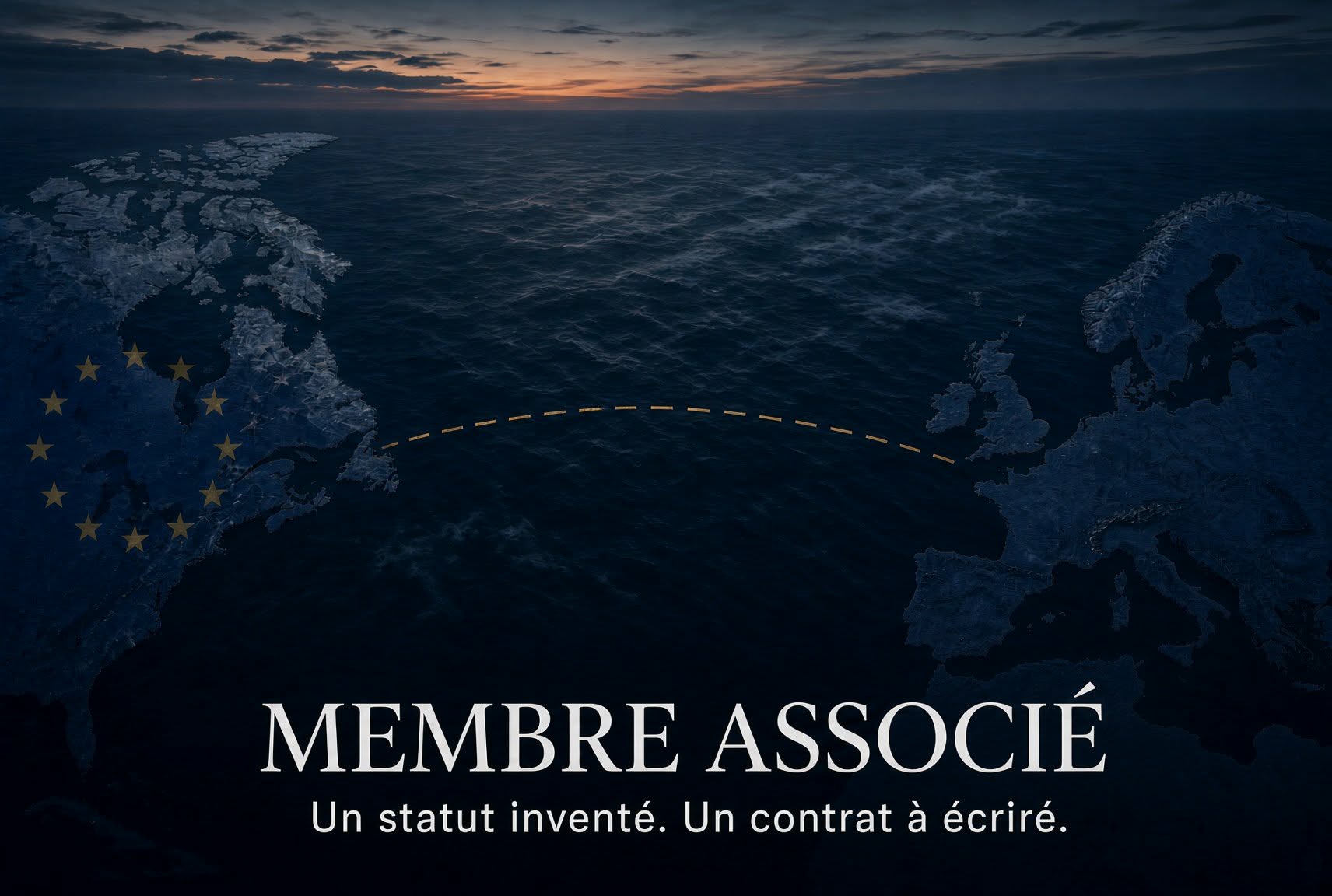
Strasbourg did what it does best: the scene. Ursula von der Leyen uttered two words that appear nowhere in the treaties — “associate member” — Mark Carney stood up, they embraced, the chamber applauded. The blue map with Canada covered in stars is already circulating. It’s clean, it’s warm, it looks as if a continent has just been stitched back together.
Except nothing has been stitched back together.
Canada is not European. The treaties say so without poetry. There is no accession vote. A status is being invented because “partner” sounds too small and “member” is legally impossible. This is label diplomacy: name it first, define it later. Not every member state had the script. Several diplomats said the same thing off the record: nobody really knows what it means. When the Commission president talks faster than the 27 capitals, that isn’t boldness. It’s a risk of overpromising.
The substance is more prosaic. Ottawa has an American problem. Not a philosophical one: a market problem, a tariff problem, a predictability problem. Brussels has a problem of reliable partners and raw materials. The two look at each other and conclude it would be stupid to stay in their corners. Fine so far. Diversifying is prudence. Turning that prudence into a transatlantic romance is something else.
Because Canada will not wake up tomorrow inside the single market. No free movement of people. No seat on the Council. No right to vote on the directives it would then have to apply if it aligns too closely. That is the classic trap of European “associations”: you take some of the rules without writing the rules. Norway has lived it for years. The United Kingdom left the club so it would not have to live it anymore. Canada would do well to look at both examples before signing anything that looks like regulatory alignment on AI, batteries, or minerals.
There is domestic politics, too. Carney is selling a “unique alliance.” Poilievre is shouting sovereignty. Both have a piece of the truth and a piece of theatre. The first is right to look for oxygen outside Washington. The second is right to ask who will pay, who will legislate, and what “associate” actually means for a steel producer, a farmer, or a worker who never asked to become Brussels-compatible. A strategic relationship is not an identity merger. Canada does not have to become a regulatory appendage of Europe in order to sell lithium or cooperate in the Arctic.
And Europe is not a haven of coherence. It has its own contradictions: energy, industry, a democratic deficit, slowness. Allying with it is not allying with a pure idea. It is allying with twenty-seven governments that do not share the same interests on cars, steel, GMOs, or national preference. Anyone who thinks the word “associate” flattens that has never watched a European Council.
The Montreal summit in late October will tell us whether this is an architecture or a communications sequence. Until the details are there — which sectors, which exceptions, what mobility, what contribution, what say — the title “associate member” remains a slogan dressed up as history.
I have nothing against closer ties. I have nothing for magic labels. Canada needs options. Europe needs allies. That is negotiated coldly, clause by clause, not with embraces and blue maps. Geography has not moved. The Atlantic is still there. So are the United States. Serious policy starts from that, not from the Strasbourg communiqué.